The 10 Best Retro Games You Can Play Right Now
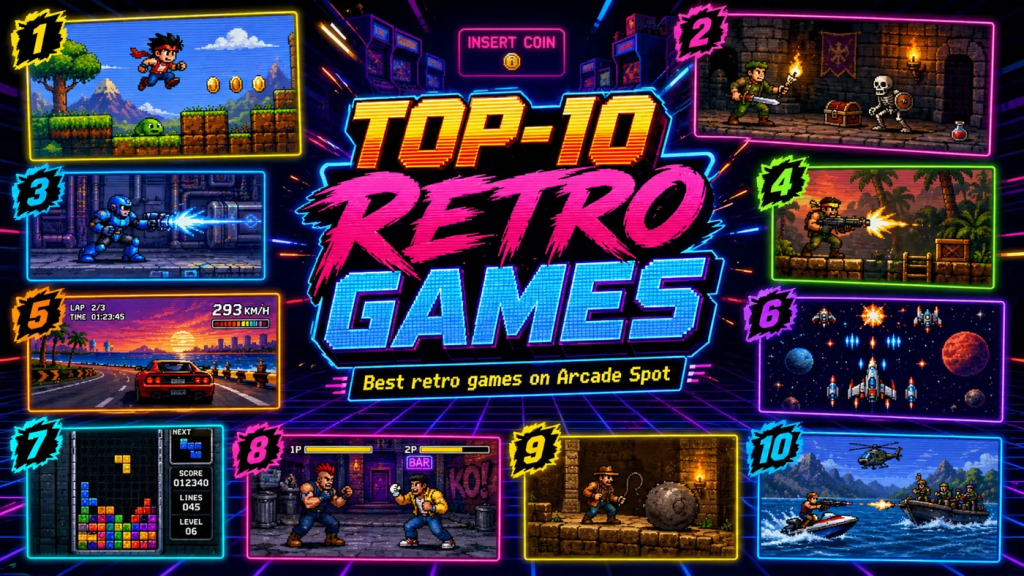
There’s a specific kind of confidence in games from the late eighties and early nineties. No tutorials, no waypoints, no apology — just a cartridge that hands you a world and expects you to work it out. This is our ranking of the ten finest examples in the Arcade Spot library: the game that invented open-world exploration, the platformer that defined a genre, a JRPG told in comic panels, and a space rabbit built by the people who would go on to found Treasure. Every one runs free in your browser.
Quick answer: The Legend of Zelda takes first place for inventing a template everyone still copies, Super Mario Bros. 3 is the most purely enjoyable thing here, and Bucky O’Hare is the one almost nobody has played and absolutely should.
A word on how this was assembled. What follows is our shortlist of the best retro games you can load in a single click, and four things decided the order: whether the design still teaches modern developers something, how well the controls survive a keyboard, whether the difficulty is fair or merely cruel, and how much of it you can enjoy in twenty minutes rather than twenty hours.
One pattern worth flagging before we start. Six of these ten came out on the same console within about seven years of each other, and that’s not an accident of availability — it’s because cartridge limitations forced a kind of discipline. When you can’t stream assets or patch a bad level later, every screen has to earn its space. That constraint produced a density of ideas that far larger games rarely match.
The ranking
1. The Legend of Zelda
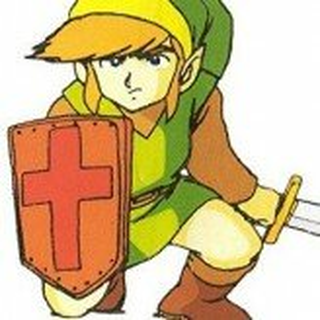
Nearly every open-world game made since owes something to this cartridge. In 1986 the standard was a single path from left to right; Nintendo instead dropped you onto a screen with a cave, an old man, a sword, and no instructions whatsoever, then let you walk in any direction you liked. There’s no tutorial, no arrow pointing anywhere, and no level gating — you can walk into the seventh dungeon in your first hour and get comprehensively destroyed.
That refusal to hold your hand is precisely why it still works. Hyrule is built to be interrogated rather than followed: burn a bush, bomb a wall, push a gravestone, and something is often hidden behind it. Progress comes from paying attention and forming theories, and the moment a hunch pays off is a feeling most modern design has quietly engineered out of existence.
It was also the first home cartridge with a battery inside, meaning you could save your game rather than scribble a password on paper — a change that made long adventures possible on consoles at all. With 296 likes from 346 ratings, it remains one of the most-played classics in the whole library, and it’s still genuinely difficult in the second quest.
Best for: Exploration and discovery • Dungeons: 9, plus a second quest • Difficulty: Unforgiving but fair
Why it takes the crown: it invented the idea that a world is something you investigate rather than travel through.
▶ Play The Legend of Zelda free on Arcade Spot
2. Super Castlevania IV

Simon Belmont’s story retold on 16-bit hardware, and the single change that transforms it is deceptively small: you can now swing the whip in all eight directions, and hold the button to let it dangle limply and wave it around. After four games of being locked into a rigid forward crack, that freedom feels enormous — and it means every enemy placement had to be redesigned from scratch.
Konami used the new hardware for atmosphere rather than spectacle. Chandeliers swing on real pendulum arcs, a spinning room rotates the entire stage around you, and a rope-swinging sequence over a chasm uses the whip as a grappling hook long before that became a genre standard. Eleven stages take you from the graveyard outside to Dracula’s throne, and each has a distinct visual idea rather than just a new tileset.
The soundtrack deserves separate mention: Simon’s Theme, Bloody Tears and the cathedral organ pieces are among the most recognisable music of the era. It’s the most atmospheric game on this list, and one of the few from 1991 that a newcomer can pick up today without any adjustment period at all.
Best for: Atmosphere and mood • Stages: 11 • Difficulty: Fair, gets steep late
Why it makes the list: eight-directional whipping rewrote the series, and the atmosphere has never been bettered.
▶ Play Super Castlevania IV free on Arcade Spot
3. Phantasy Star IV

The only role-playing game on this list, and it earns the spot by being the finest thing Sega ever published in the genre. Chaz Ashley takes what looks like a routine monster-clearing contract on the desert world of Motavia; several dozen hours later he’s fighting for the survival of an entire star system, in a story that closes out a saga spanning a thousand years of in-universe history.
The presentation is what makes it feel modern. Rather than static text boxes, key scenes play out through hand-drawn manga panels that slide across the screen — a technique nobody else was using in 1993, and one that gives the whole game the rhythm of a comic you happen to control. There’s also a macro system that records command sequences for one-button replay, quietly removing the tedium from random encounters.
Combat rewards curiosity in the same way Zelda does. Combination techniques let party members chain abilities into devastating joint attacks, but the game never tells you which pairings exist — you find them by experimenting, and stumbling onto a new one deep into the campaign is a genuine thrill. Bring time for this one; it’s easily the longest game here.
Best for: Story and scale • Party: Up to 5 active • Difficulty: Fair, rarely cruel
Why it makes the list: manga-panel storytelling and hidden combination attacks put it years ahead of its peers.
▶ Play Phantasy Star IV free on Arcade Spot
4. Mega Man 2
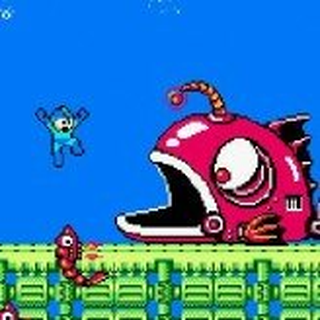
The original sold poorly enough that Capcom nearly abandoned the idea; the team made the sequel in their own time, on the condition it wouldn’t interfere with their assigned projects. What came out is the game that defined the series and, arguably, a whole approach to level design: eight robot masters, tackled in any order you choose, each dropping a weapon that happens to shred a specific rival.
That structure is quietly brilliant. Choosing your own route means an early wall is never fatal — struggling with Quick Man just means going elsewhere, coming back with Time Stopper, and watching the fight collapse in seconds. Working out the correct chain of eight is a puzzle layered on top of the platforming, and it’s the reason people still argue about optimal orders decades later.
The additions matter too. Energy tanks let you bank health for emergencies, an E-Tank spent well can save a run, and password saving means you don’t lose everything to one bad session. Add Takashi Tateishi’s soundtrack — the Dr. Wily stage theme is arguably the most covered piece of chiptune music ever written — and you get the most polished eight-bit action game ever made.
Best for: Pattern learning • Bosses: 8, any order • Difficulty: Tough but never unfair
Why it makes the list: choosing your own order turned difficulty into a puzzle instead of a wall.
▶ Play Mega Man 2 free on Arcade Spot
5. Contra

Two commandos, an alien-infested island fortress, and a difficulty level that turned an entire generation into people who memorise things. Bill Rizer and Lance Bean die in one hit, which sounds punishing until you realise it makes the game read like a rhythm test — every enemy appears at a fixed moment, every jump has a correct timing, and mastery means the whole stage becoming a performance you’ve rehearsed.
The Spread Gun is the most famous power-up in eight-bit gaming for good reason: grab it and the screen fills with a fan of bullets that trivialises entire sections. Losing it to a stray shot is genuinely upsetting, which gives every hit a weight most shooters can’t manage. Two-player co-op is where it really comes alive, mostly because you’ll spend it accusing each other of stealing power-ups.
The pseudo-3D corridor stages, where you run into the screen dodging electric barriers, were a technical flex nobody expected on this hardware. And then there’s the Konami Code — up, up, down, down, left, right, left, right, B, A — which grants thirty lives and is probably the single most widely-known cheat in the medium. Arcade Spot lists it directly on the game page, so there’s no excuse for suffering.
Best for: Co-op chaos • Signature: Spread Gun • Difficulty: Brutal without the code
Why it makes the list: the purest memorisation challenge of the era, plus the most famous cheat code ever written.
▶ Play Contra free on Arcade Spot
6. Super Mario Bros. 3

Placing this sixth will annoy people, so here’s the reasoning: it is the most enjoyable game on this list and the least surprising. Everything it does, it does perfectly — but the ideas above it changed what games could be, while this one perfected what they already were. That’s not a criticism so much as an acknowledgement of how complete it feels.
The suits are the headline. The Tanooki suit turns you to stone; the Frog suit rewrites swimming physics entirely; the Hammer Bros suit lets you throw things and duck under fireballs; and the Super Leaf gives you a flight mechanic that the level design is quietly built around. Eight worlds each get their own visual language, from desert to ice to a world where everything is enormous.
The world map was the structural innovation, adding routes, optional levels, mini-games, hidden warp whistles and Toad houses between stages. It sold 18 million copies and was the centrepiece of a feature film that was essentially a two-hour advertisement for it. On Arcade Spot it holds 1,355 likes from 1,594 ratings, making it the most-played entry here by a wide margin.
Best for: Everyone, always • Worlds: 8, plus warp whistles • Difficulty: Gentle to fierce
Why it makes the list: the most polished platformer of the era, and the world map changed how games are structured.
▶ Play Super Mario Bros. 3 free on Arcade Spot
7. Teenage Mutant Ninja Turtles III
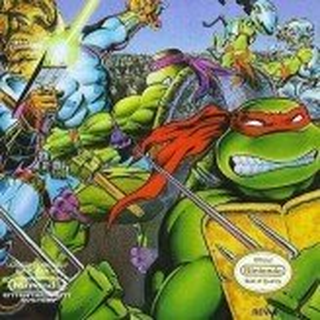
Subtitled The Manhattan Project, this is the entry that gets overlooked because everybody remembers Turtles in Time on the SNES instead. That’s unfair. This was built specifically for the NES rather than squeezed down from a coin-op cabinet, which means Konami designed around the hardware’s limits instead of fighting them — and the result is smoother and better paced than the arcade conversion that preceded it.
Each turtle finally feels distinct. Donatello’s staff gives him the longest reach and the weakest hits; Raphael’s sai are short and vicious; Leonardo and Michelangelo sit in between with different attack speeds. Every one also gets a special attack that costs a little health, so throwing one out is a decision rather than a reflex.
The stages are more inventive than the genre usually manages: a beach, a surfboard section, an airship, and a boss fight against a shark. Two-player co-op runs the whole way through, and unlike the arcade game it isn’t secretly engineered to drain your lives so you’ll insert more money. If you only ever played the SNES sequel, this is a genuinely rewarding gap to fill.
Best for: Couch co-op • Characters: 4, all distinct • Difficulty: Moderate
Why it makes the list: built for the hardware rather than shrunk onto it, and the better co-op experience for it.
▶ Play Teenage Mutant Ninja Turtles III free on Arcade Spot
8. Ice Climber
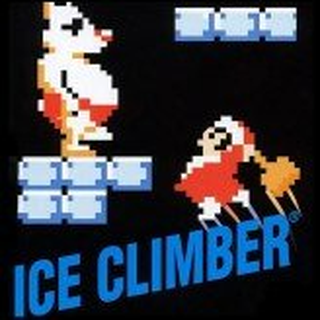
The oldest game here and the strangest premise: a condor has stolen your vegetables, so you take a wooden mallet and climb a mountain to get them back. Popo and Nana smash upward through ice ceilings across 32 mountains, dodging yetis and polar bears, with a bonus stage at the summit where you try to grab the bird’s tail feathers before time runs out.
It’s here partly for historical weight — this is one of the original NES launch-era black box titles, and the Ice Climbers became famous decades later as an unexpectedly technical Super Smash Bros. pick — but mostly because the jump is so peculiar. It’s floaty, has almost no horizontal control once you leave the ground, and the ceilings you smash create the platforms you land on. Nothing else on this list controls remotely like it.
Be honest with yourself about what you’re signing up for: this is arcade-era design, meaning high scores rather than an ending, and the two-player mode is co-operative mainly in theory. Everyone eventually starts knocking their partner off ledges. It’s the shortest, sharpest, silliest thing here, and perfect for ten minutes.
Best for: A ten-minute blast • Mountains: 32 • Difficulty: Awkward by design
Why it makes the list: a jump so odd nobody has ever copied it, and a mallet-versus-condor plot nobody has ever bettered.
▶ Play Ice Climber free on Arcade Spot
9. Rygar
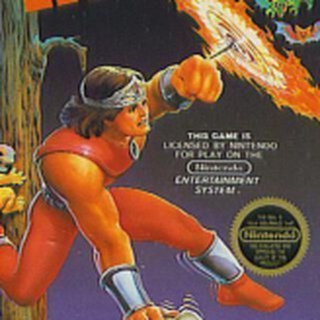
Rygar began life as a straightforward coin-op scrolling brawler, and Tecmo then did something unusual with the home version: they threw out the linear structure entirely and rebuilt it as a connected world with backtracking, unlockable traversal abilities and both side-scrolling and overhead sections. The console version and the cabinet share a name and almost nothing else.
Your weapon is the Diskarmor, a shield on a chain that you fling forward and retract — closer to a yo-yo than a sword, and it takes a while to stop mistiming it. As you progress you earn items that reshape the map: a grappling hook for cliffs you couldn’t reach, a crossbow for gaps, and a pulley that opens entire regions. Coming back to an old area with a new tool is the whole loop.
This came out in 1987, several years before that structure had a name, and it’s a genuinely overlooked ancestor of the exploration-platformer. It’s cryptic in places and expects you to map things mentally, which is a real barrier — but if you liked what Zelda does with hidden routes and want it side-on, this is the one to try.
Best for: Backtracking explorers • Weapon: The Diskarmor • Difficulty: Cryptic and demanding
Why it makes the list: an exploration-platformer built years before anyone had a word for the genre.
▶ Play Rygar free on Arcade Spot
10. Bucky O’Hare
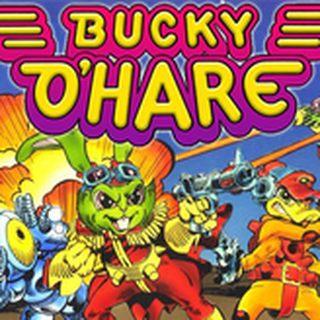
A green space rabbit captaining a ship called the Righteous Indignation against an empire of imperialist toads — this is exactly as strange as it sounds, and it comes from a comic by Larry Hama that became a cartoon that became two entirely different Konami games in 1992. The version here is the coin-op: a four-player scrolling run-and-gun where every character fights with a laser pistol rather than fists.
You pick from Bucky, the telepathic cat Jenny, the four-armed duck Dead-Eye, or the one-eyed android Blinky, and work through planets in the Aniverse freeing prisoners from cells you shoot open. Each character carries a limited stock of smart bombs, and the game is stingy enough with health that banking those bombs for boss fights is the difference between finishing a stage and feeding it more credits.
The reason it closes this list is the credits rather than the gameplay. Konami staff who worked on the Bucky project pitched an idea that management rejected, then left to found Treasure — the studio behind Gunstar Heroes, Radiant Silvergun and Ikaruga. Play it and you’re watching a group of developers a few months before they went off to reshape the action genre entirely.
Best for: Coin-op curiosities • Players: Up to 4 • Difficulty: Quarter-hungry
Why it makes the list: the last Konami project before its team walked out and founded Treasure.
▶ Play Bucky O’Hare free on Arcade Spot
The full lineup at a glance
EVERY PICK, SIDE BY SIDE
| Pos | Title | Year | System | Best for |
|---|---|---|---|---|
| 1 | The Legend of Zelda | 1986 | NES | Exploration |
| 2 | Super Castlevania IV | 1991 | SNES | Atmosphere |
| 3 | Phantasy Star IV | 1993 | Genesis | Story and scale |
| 4 | Mega Man 2 | 1988 | NES | Pattern learning |
| 5 | Contra | 1987 | NES | Co-op chaos |
| 6 | Super Mario Bros. 3 | 1988 | NES | Pure enjoyment |
| 7 | Teenage Mutant Ninja Turtles III | 1991 | NES | Couch co-op |
| 8 | Ice Climber | 1985 | NES | Quick sessions |
| 9 | Rygar | 1987 | NES | Backtracking |
| 10 | Bucky O’Hare | 1992 | Arcade | Cult curiosity |
Which one should you start with?
Ten links is a lot to stare at, so if you can’t decide where to begin, here’s the shortcut through the best retro games above:
- You’ve got fifteen minutes: Super Mario Bros. 3, or Ice Climber if you want something you’ve genuinely never played.
- You want to get lost in something: The Legend of Zelda. Take notes on paper like it’s 1986 — that’s the intended experience.
- Someone’s on the sofa with you: Contra for the arguing, Teenage Mutant Ninja Turtles III for the co-op that actually works.
- You’ve got a whole weekend: Phantasy Star IV. Nothing else here will hold you for that long.
- You want to feel like you found something: Rygar, then Bucky O’Hare. Both are cult picks for good reason.
Just missed the cut
Several more deserve your evening. Metroid is the other great 1986 exploration game and arguably belongs in the ten. Kirby’s Adventure squeezed astonishing visuals out of ageing hardware right at the end of its life, Duck Tales has the pogo-stick mechanic and a Moon theme people still hum, Battletoads remains the cruellest game anybody finished, and Mike Tyson’s Punch Out is still the best pattern-reading challenge on the system. You’ll find all of them and hundreds more in the full retro library and the NES collection.
Bottom line: The Legend of Zelda is the one that mattered most, Super Mario Bros. 3 is the one you’ll enjoy most, and Bucky O’Hare is the one you’ll be pleased you tried. These are the top retro games in the library, and every one of them is sitting on Arcade Spot right now — free, no download, no install, no thirty-year-old cartridge required.