
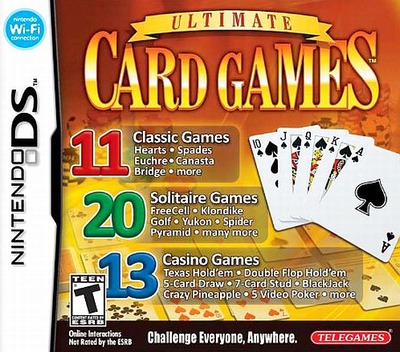









Ultimate Card Games
Exploring the timeless tactical loops of traditional card compilations requires zero hardware baggage in 2026. You can experience the incredible breadth of Ultimate Card Games by launching optimized HTML5 web emulation boxes for an instant browser matchup, running uncompressed localized emulation files within standalone desktop programs, or managing complex hand organizations across portable smartphone viewports.
Originally a robust GBA/DS cartridge compilation, this all-in-one digital casino and parlor repository delivers Solitaire, Blackjack, Spades, Hearts, Texas Hold ’em, Cribbage and more from a single interface — each sub-game hot-swaps its rule engine on selection while maintaining zero-latency rendering. The AI calculates risk from visible board cards, past discards, and aggression settings rather than reading your hand directly from memory.
🖥️ Where to Play Ultimate Card Games Today
Safe web layers offer direct access without rare cartridges or unverified software installations:
🌐 HTML5 WebAssembly Handheld Emulation
The entire compiled retro cartridge architecture executes beautifully inside modern browser-compatible emulation capsules — run Ultimate Card Games directly inside an open internet browser window with zero local storage requirements, drive fragmentation, or security warnings.
🎮 Gamepad & Touchscreen Input API
Browser ports support plug-and-play controller and mouse configurations. Navigating card grids and organizing complex hands maps fluidly to native cursor movements or smartphone touch coordinates — replacing clunky button command navigation with smooth arcade responsiveness.
💾 SRAM Browser Save-State Arrays
Active progression logs, unlocked player avatars, and cumulative bankroll earnings write directly to local browser cookies — pause a long tournament and return later without losing cleared records or career milestone progress.
Browser (WebAssembly)
GBA/DS Emulator
USB Gamepad
Mobile Touch
SRAM Browser Save
Four Primary Game Modes
🃏
Klondike Solitaire
Single 52-card pack · 7-column tableau
Always prioritize uncovering face-down cards in the deepest columns before merging visible chains. Blind merging buries vital low cards under unorganized stacks.
🎰
Classic Blackjack
Multi-deck shoe · 3-seat dealer arc
Card-counting variance audit — track suit distribution across the multi-deck shoe. Never raise bets until the deck composition strongly favors high-value cards.
♠️
Four-Player Spades
Fixed partnership · 4-quadrant field
Count active suit drops per round. When three consecutive low cards of a suit drop, remaining players are out — withhold Ace/King anchors until the defensive cards are bled away.
🃏
Texas Hold ’em
Shared community pool · Flop/Turn/River
Positional pot capitalization — the AI calculates from visible board cards and past discard behavior, not hand memory. Play to your position relative to the dealer button.
Three Core Computational Systems & Key Numbers
⚙️ Three Mechanical Divisions
-
🎲 High-Entropy Linear Shuffle Engine
Multiple background RNG calculations per frame ensure every draw triggers a genuinely unpredictable probability value — eliminating historical pattern exploitation that plagued older card game code. Speed-hacking beyond 300fps overflows the timing loop and triggers an accidental all-Joker deck swap.
-
🔄 Hot-Swap Modular Ruleset Verification
Sub-game selection instantly hot-swaps the underlying winning condition code blocks and deck layout boundaries. Switching from Solitaire to Texas Hold ’em loads an entirely different rule engine while maintaining identical zero-latency rendering performance.
-
🤖 Risk-Calculated AI Opponent Profiles
AI calculates risk percentages from visible board cards, past discard choices, and configured aggression settings — not from reading your hand memory directly. Higher aggression profiles bluff more frequently on weak boards; conservative profiles only bet on strong confirmed hands.
📊 Ultimate Card Games — Key Numbers
| Parameter |
Value |
| 🎮 Original Platform |
GBA / Nintendo DS |
| 🃏 Standard Deck Size |
52 cards |
| ⚠️ Speed-Hack Overflow Threshold |
> 300 fps |
| 🖥️ Display Aspect Ratio |
4:3 integer lock |
| 💾 Save Method |
SRAM browser cookies |
| 🤖 AI Data Source |
Visible board + discards |
Then vs. Now
📼 1990 — Low-Res 8-Bit Card Cartridges
Clunky low-resolution 8-bit cartridges with highly predictable dealer patterns, text-only menus, and strict memory limits supporting only 3–4 basic variants. Unoptimized pseudo-random number generators caused dealers to repeat identical card sequences — completely breaking the statistical foundations of tactical card matching.
🎯 Today — Multi-Game Browser Anthology
Immersive multi-game 16-bit and 32-bit digital anthologies on high-speed emulation layers — fluid hand sorting, human-like AI routines calculating from visible board state, hot-swap rule modules, and smooth browser execution. SRAM cookies preserve bankroll and tournament progress indefinitely between sessions.
Expert Tactics — Spades Counting & Solitaire Hidden-Cell Priority
♠️ Spades — Suit Drop Counting
-
🚫 Never Release Ace/King in the First Two Tricks
The most common rookie mistake is releasing high-value Trump cards during opening trick cycles — leaving your hand completely vulnerable during critical late-game phases where point scoring peaks.
-
🔢 Count Consecutive Low-Card Drops Per Suit
When the dealer leads a heart and your opponents discard three consecutive low hearts, the probability matrix confirms the remaining players are out of that suit. This is your signal — withhold Ace and King assets for later rounds when defensive cards have been bled away.
-
🎰 Blackjack — Track Shoe Composition
In the multi-deck Blackjack shoe, never raise bet sizing until deck composition strongly favors high-value cards. Premature aggression against a cold shoe drains bankroll on unfavorable probability distributions.
🃏 Solitaire — Hidden Cell Discovery Priority
-
🚫 Never Merge Visible Cards Blindly
Moving any visible alternating-color match the moment it appears creates long unorganized stacks that bury vital low cards. Evaluate the vertical depth of every column before executing any move — visible merges that don’t uncover face-down cards are usually counterproductive.
-
🔍 Always Target the Column with Most Face-Down Cards
Prioritize clearing cards from the vertical lane containing the largest number of face-down tiles. Uncovering hidden cells early expands your active spatial layout — preventing premature blockage and keeping options fluid as the preview deck shrinks.
-
🤖 AI Adapts to Your Discard History
In multiplayer modes, the AI observes your past discard patterns alongside visible board state. Vary your discard strategy deliberately to prevent the AI from accurately profiling your hand composition during late-game high-stakes trick phases.
Technical Setup
⚙️ Emulator & Display Configuration
🖥️ Locked 4:3 Integer Aspect Frame
Retro compilation assets were illustrated for smaller square digital configurations. Forcing a 16:9 widescreen stretch warps card dimensions and makes numerical indices difficult to read — toggle a locked 4:3 integer aspect frame inside your video settings for all sub-games.
💾 SRAM — No Privacy Cleaning Post-Session
Browser preservation systems use temporary local cookies to manage ongoing tournament saves, career bankroll milestones, and unlocked custom card backs. Avoid aggressive automatic privacy cleaning tools right after playing to keep your Ultimate Card Games files secure.
🖱️ Cursor Polling — Click-Accurate Profile
Calibrate your mouse pointer’s reporting precision in your OS control menu for smooth click-for-click card drag actions on the virtual tabletop. Input drift causes accidental card drops onto wrong tableau columns — especially costly during Solitaire hidden-cell discovery sequences.
♠️ Spades Anchor Timing: The optimal window to release Ace and King anchor cards is after three opponents have discarded low cards of the same suit in one round — confirming they are fully out of that suit and cannot counter your high-value plays. Releasing anchors before this signal guarantees they will be neutralized by opponents who still hold mid-tier cards of that suit. Patience with high-value anchors is the primary statistical differentiator between beginner and advanced Spades play.
⚠️ Input Latency Warning: Selecting the correct card and timing bidding choices requires interface clicks within narrow millisecond boundaries. Any display stutter causes misclicked card drops — especially costly in Solitaire when a wrong column placement buries a needed low card. Enable Hardware Acceleration at its highest active profile in your browser’s advanced configuration hub and close memory-heavy background applications for perfectly fluid, constant rendering.
Summary of Tactics
1
In Spades, hold Ace/King anchors until three consecutive low cards of their suit have dropped — confirming opponents are out and your anchors are safe to play uncontested.
2
In Solitaire, always target the column with the most face-down cards — uncovering hidden cells early prevents premature blockage as the preview deck shrinks.
3
Never merge visible Solitaire cards blindly — evaluate whether the move uncovers a face-down tile before committing. Stack-building without revealing hidden cards is almost always counterproductive.
4
In Blackjack, never raise bet sizing until the multi-deck shoe composition clearly favors high-value cards — premature aggression against a cold shoe drains bankroll on unfavorable odds.
5
Vary your discard patterns in multiplayer modes — the AI adapts its probability model from your discard history. Predictable discards allow the AI to accurately profile your hand.
6
Lock display to 4:3 integer aspect — widescreen stretching makes numerical indices on card corners difficult to read and distorts spatial column-depth perception in Solitaire.
The brilliant, highly unique engineering behind this expansive digital anthology continues to hold a revered position among retro strategy fans, development historians, and casual browser game preservationists worldwide. By packing intricate probability math, cooperative partnership logic, and a deeply rewarding career progression model into an open-access configuration, Ultimate Card Games demonstrates how classical physical entertainment can be beautifully preserved and enhanced through digital technology. Analyze your current hand — and play to the probability.