




Squid Challenge Glass Bridge
Engaging with raw, high-tension behavioral logic requires zero local hardware bloat in 2026. You can cross the treacherous platforms of Squid Challenge Glass Bridge by running optimized HTML5 web-player envelopes for an instant in-browser matchup, deploying localized simulation suites on desktop layouts, or plotting survival directions across portable mobile viewports.
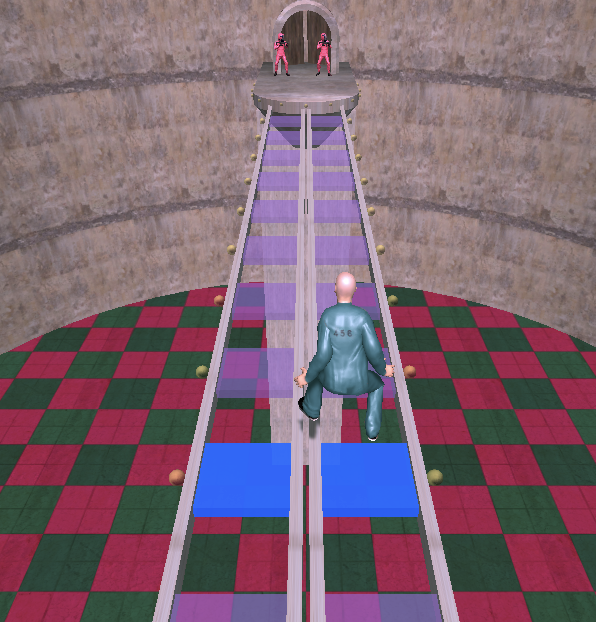
Inspired directly by the iconic survival tournament formula popularized on streaming networks, this intense memory game forces players to cross an elevated suspension structure of sequential side-by-side tile pairings — one tempered load-bearing panel, one brittle instant-shatter panel. At the Grandmaster tier: 22 rows, a 2.0-second flash window, and an 11% clearance rate. The path generator never produces more than three consecutive identical-side tiles — blind guessing is statistically fatal.
🖥️ Where to Play Squid Challenge Glass Bridge Today
Secure game repositories provide immediate access without local installations or console emulators:
🌐 HTML5 Modernized Browser Catalogs
The primary standalone variations execute smoothly inside standard web browser configurations — launch Squid Challenge Glass Bridge instantly across desktop or laptop architectures, eliminating the need for multimedia plugins or localized storage.
📁 Agame & Girls Go Games Portals
Fully optimized instances are hosted directly on popular community portals including Agame and Girls Go Games, ensuring stable access to historical leaderboard data, user comment forums, and original high-score trackers.
🖱️ Cursor & Keyboard Input Conversion
The web player maps directional keyboard clicks or direct mouse cursor interactions to jump targets — executing a lateral step requires zero complex multi-button inputs, making it immediately accessible to all skill levels.
Browser (HTML5)
Agame
Girls Go Games
Mobile Browser
Three Tournament Difficulty Stages
🟢
68%
🟢 Beginner
Level 1 — Beginner
10 rows · 5.0s flash
Full 5 seconds to absorb the path. Practice converting Left/Right positions into binary code blocks (1=Left, 2=Right) before the time pressure intensifies.
🟡
34%
🟡 Intermediary
Level 2 — Intermediary
16 rows · 3.5s flash
The chunking method becomes mandatory here — 3.5 seconds for 16 rows. Split the sequence into groups of 3-4 and repeat each sub-code vocally before advancing.
🔴
11%
🔴 Grandmaster
Level 3 — Grandmaster
22 rows · 2.0s flash
2.0 seconds for 22 rows — hyper-focused visual retention only. The path generator caps consecutive same-side tiles at 3, so any run of 4+ identical directions is always a shattering panel.
Core Mechanics & Key Numbers
⚙️ Three Core Mechanical Systems
-
⚡ Brief Geometric Flash Array
At the opening of each level, the engine illuminates the safe structural panels in a forward chain for a narrow time window. This is the only opportunity to absorb the path — once the flash ends, the tiles become visually identical.
-
💥 Binary Shatter Collision Algorithm
Each tile has a strict material value — 1 = tempered load-bearing, 0 = brittle instant-shatter. Landing on a zero-value tile immediately terminates vertical support and launches an unalterable falling sequence. No recovery mechanic exists.
-
⏱️ Linear Countdown Pressure Sub-Routine
A real-time countdown clock drains your movement window continuously. Pausing too long on a safe platform to recalculate a forgotten path segment results in automatic tournament elimination when the timer hits zero.
📊 Squid Challenge Glass Bridge — Key Numbers
| Parameter |
Value |
| 🟢 Beginner Flash Window |
5.0 seconds |
| 🟡 Intermediate Flash Window |
3.5 seconds |
| 🔴 Grandmaster Flash Window |
2.0 seconds |
| 🔢 Max Consecutive Same-Side Tiles |
3 (never 4+) |
| ⏱️ Optimal Jump Buffer Delay |
0.8 seconds |
| 🏆 Grandmaster Clearance Rate |
11% |
Then vs. Now
📼 Early Web Survival Puzzle Era
Flat text-adventure decision blocks and static 2D grid drawings with basic mouse-click tracking and zero physics simulation. Traditional web puzzles lacked structural consequence — wrong answers produced a text message, not a falling animation or a real-time countdown that eliminates you on zero.
🎯 Today — Pseudo-3D Memory Survival
Immersive pseudo-3D engine layouts, real-world high-stakes tournament rule designs, real-time countdown mechanics, and smooth performance running instantly inside an open browser tab. The path generator’s anti-repetition algorithm (max 3 consecutive same-side tiles) ensures the game is never solvable by pattern abuse.
Expert Tactics — Binary Chunking & 0.8s Jump Buffering
🔢 Binary Chunking Memory Method
-
🔢 Convert Path to Number Codes (1=Left, 2=Right)
Do not try to visualize individual tiles as they illuminate. Convert the left/right positions into a fast binary string — Left=1, Right=2. Group into clusters of 3: if the flash shows Left, Left, Right, Left, Right, Right, your code is “11-21-22.”
L · L · R · L · R · R
→ binary chunk code → “11-21-22”
-
🗣️ Repeat the Chant While Jumping
Repeat the rhythmic number chant vocally while executing your jumps — this lets your brain bypass visual memory fatigue entirely, mapping correct movement commands without hesitation at crowded intersections mid-bridge.
-
🔍 Opacity Texture Hint for Missed Sections
If you miss a section of the flash — reinforced load-bearing panels have a subtly darker opacity filter compared to fragile tiles. Examine glass texture closely at close range to identify this minor visual hint before committing a jump.
⏱️ 0.8-Second Jump Buffer Discipline
-
🚫 Never Sprint Then Pause — Maintain Consistent Tempo
The most common amateur mistake is rushing the first five panels, then stopping for four seconds to recall the rest. This erratic pacing disrupts rhythmic timing and causes panic-missed targets. Consistent tempo is more important than raw speed.
-
⏱️ Allocate Exactly 0.8 Seconds Between Jumps
A deliberate 0.8-second buffer between every jump creates a consistent rolling locomotion speed — staying safely ahead of the draining clock while providing a stable processing window to queue up the next directional code block.
-
🤖 Let AI Bots Map the Route When Available
If the level populates the bridge with automated AI contestants ahead of you, stand back on the starting platform and watch which panels they break. Let them map the safe route at zero risk to your own run before stepping forward.
Technical Setup
⚙️ Display & Input Configuration
🖥️ 16:9 Landscape — Full Browser Window
The original environment layout was drawn for modern panoramic landscape ratios. Forcing a narrow vertical viewport clips side border regions and limits your horizontal field of view — making it impossible to see upcoming layout tile pairs accurately before you step onto them.
💾 Local Cache — No Cleaning Post-Session
Browser-bound survival simulations use temporary local cookies to store current level tiers, accumulated point records, and highest tournament completion counts. Avoid aggressive third-party data cleaning software right after a session to protect your Squid Challenge Glass Bridge achievements.
⌨️ Anti-Bounce Input Calibration
Set your mouse or keyboard command repeat delay to a stable profile to prevent accidental double-clicks from launching your character forward onto unverified glass tiles. A single misfire mid-bridge is an irreversible elimination — anti-bounce settings are critical.
🔢 Pattern Generator Rule: The path-building script actively prevents more than three consecutive identical-side tiles from generating. This means any run of 4 or more Left or Right steps in a sequence is always a shattering panel — this is the only structural rule you can exploit during missed flash sections. If your code says “1111,” the fourth tile is statistically impossible to be safe.
⚠️ Input Latency Warning: Navigating narrow glass pathways and timing platform leaps requires button triggers within strict millisecond boundaries. Any display stutter causes accidental diagonal trajectory drops. Enable Hardware Acceleration at its highest performance profile in your browser’s advanced settings panel and close non-essential background applications to keep rendering speeds smooth and fluid during Squid Challenge Glass Bridge runs.
Summary of Tactics
1
Convert the path flash into binary code groups (1=Left, 2=Right) in clusters of 3 — chant the code vocally while jumping to bypass visual memory fatigue entirely.
2
Maintain a strict 0.8-second delay between every jump — consistent tempo beats the clock more reliably than sprinting then stopping to recall the next tile.
3
The generator caps same-side runs at 3 tiles — any 4th consecutive same-direction jump is always a shattering panel. Use this to eliminate impossible options when you miss part of the flash.
4
If AI bots are present, wait and watch which tiles they break before stepping forward — they map the safe route at zero risk to your own life.
5
Align your character’s feet to the center of a tile before confirming a jump — the collision check is a center-front point, not the full foot silhouette.
6
Examine glass texture opacity closely when you miss a flash section — reinforced panels have a subtly darker tint compared to fragile panels at close inspection range.
The deeply engaging, high-tension design behind this independent browser release continues to hold an incredibly popular position among strategy fans and casual puzzle runners worldwide. By packing distinctive memory-retention puzzles, real-time countdown constraints, and a beautifully polished high-stakes visual template into an accessible format, Squid Challenge Glass Bridge delivers a spectacular retro-inspired playground that proves focused, skill-based independent web software can turn any casual lunch break into a thrilling test of concentration and raw psychological courage. One wrong step — and it’s over.