
Donkey Kong Land 3: The Kong Adventure That Outgrew Its Hardware
In October 1997 the original Game Boy was six years old and supposedly finished. Rare shipped this anyway: 36 levels of pre-rendered sprite work squeezed into a monochrome cartridge, with two playable Kongs running on deliberately different physics. It stands as the technical high point of that handheld’s entire lifespan, and it’s playable free in your browser right now — no cartridge, no emulator setup, nothing to install.
Rare’s last word on the original Game Boy — and it still holds up.
Quick answer: Dixie and Kiddy Kong chase Baron K. Roolenstein across the Northern Kremisphere. Dixie is your traversal specialist — her helicopter spin cuts descent speed by 42.5% and buys 14 extra frames of horizontal flight. Kiddy is heavier and unlocks secret routes by skipping across water. Learn both and 103% is achievable; favour one and you’ll stall.
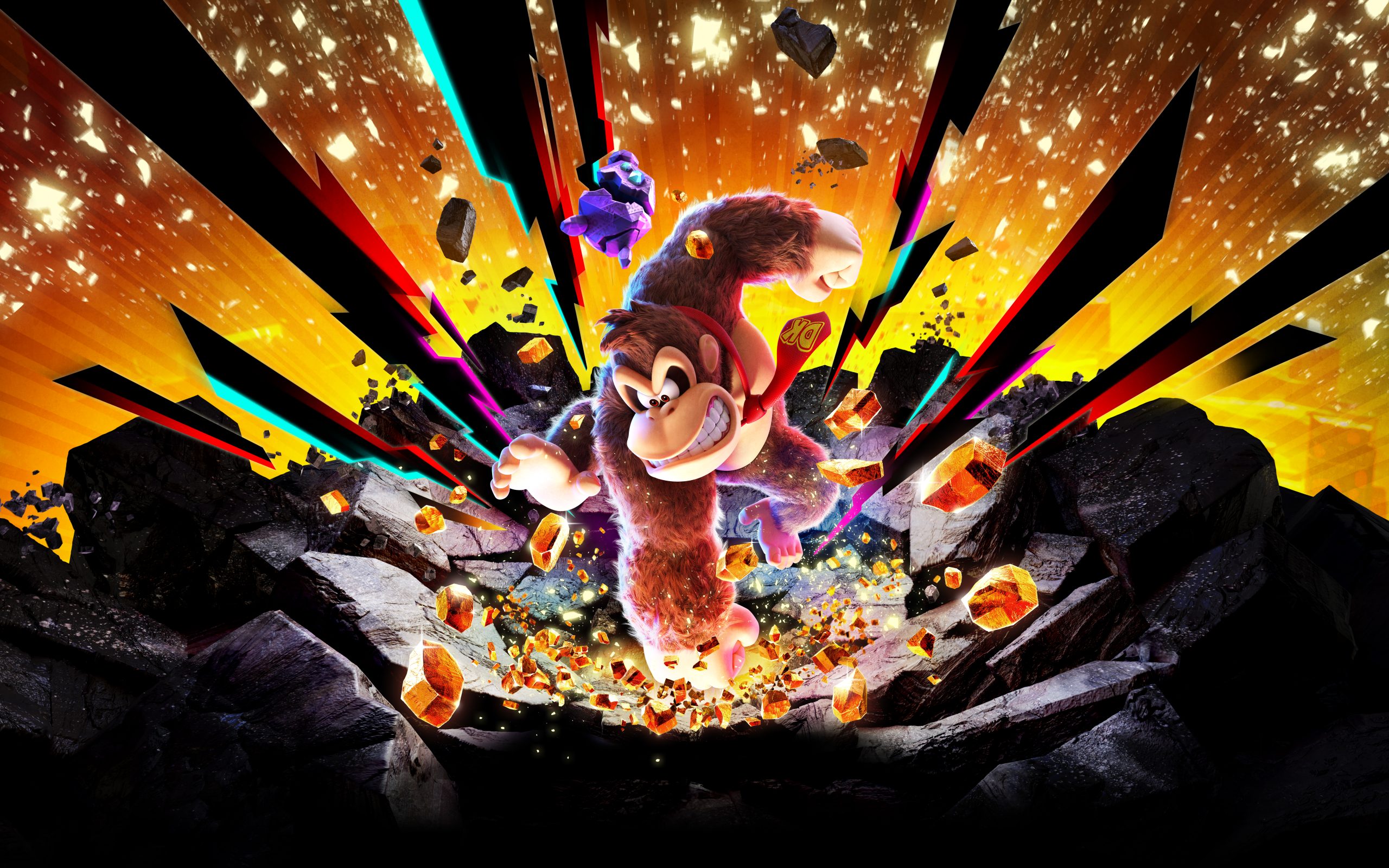
▶ Play Donkey Kong Land 3 free on Arcade Spot
From barrels to bananas: how a ladder-climbing ape ended up here
Worth clearing up first, because the naming confuses people constantly. If you came looking for the donkey kong arcade game — the 1981 coin-op where a carpenter climbs girders while an ape hurls barrels at him — that’s a different title entirely, and you can play the original cabinet here. Same character, sixteen years earlier, completely different design.
What happened in between matters. The 1981 machine made Nintendo’s name in North America and introduced both Mario and its titular ape, but the character then sat mostly unused for a decade. Rare revived him in 1994 with Country on the Super Nintendo, replacing the single-screen barrel dodging with a side-scrolling platformer built from pre-rendered 3D models. That reinvention was so successful it spawned a handheld sub-series — Donkey Kong Land — of which this is the third and final entry.
So the lineage runs: coin-op puzzle-platformer, long gap, 16-bit console platformer, then three handheld follow-ups. Land 3 is the end of that chain, and it inherits almost nothing from the arcade cabinet except a name and a gorilla. If barrels and girders are what you want, take the link above. If you want the deepest platformer the original Game Boy ever received, stay here.
What Donkey Kong Land 3 actually is
A side-scrolling platformer for two characters, set in the Northern Kremisphere — a region north of the usual jungle setting, taking in mountains, waterfalls, factories and frozen wastes. Dixie and her infant cousin Kiddy are hunting a lost world and, inevitably, running into Baron K. Roolenstein, the Kremling king in a mechanised new guise.
The structure is standard for the sub-series: a world map, a run of levels per world, a boss at the end of each, and collectables hidden throughout every stage. What isn’t standard is the technical ambition. Rare rendered character and enemy sprites as 3D models on Silicon Graphics workstations, then compressed the results into an 8-bit memory bank — giving a monochrome handheld the visual weight of a 16-bit console release.
The pair travel together, one active and one following. You swap between them freely, and because their movement differs so sharply, that swap is a real tactical decision rather than a cosmetic one. Lose a partner to damage and you continue solo with no health buffer at all, which is the single most common cause of a failed boss attempt.
The short version: a full 16-bit-style platformer on 1997 handheld hardware, with two characters who genuinely play differently.
Dixie vs Kiddy: two characters, two sets of physics
This is the mechanical heart of the game, and it’s what separates Land 3 from a straightforward jump-and-run. The two characters aren’t reskins with different sprites — their weight values differ, and levels are built assuming you’ll switch.
Dixie — aerodynamic, traversal specialist
Hold the jump button in mid-air and her ponytail spins into a rotor. Descent speed drops by 42.5%, granting 14 additional physics frames of horizontal flight — the exact margin the widest bottomless chasms are designed around.
Activate the spin as early in the jump arc as possible. Waiting until you’re already falling wastes most of the drift window and is why people insist certain gaps are impossible.
Kiddy — heavy mass, secret route specialist
His higher mass value unlocks the water roll skip: roll off a solid ledge onto water at the right angle and he bounces across the surface instead of sinking, bypassing submerged enemy groups and reaching isolated paths.
He’s also the better thrower. Because mass generates launch force, Kiddy throwing Dixie upward reaches elevated bonus areas that the reverse pairing can’t.
The practical rule: explore with Dixie, solve with Kiddy. Anything involving a long gap, a slow controlled descent or a tight aerial landing goes to Dixie. Anything involving water surfaces, upward launches or brute reach goes to Kiddy. Several of the hidden routes required for full completion are only reachable by one specific character, so a run that never switches will simply hit a wall.
The four animal helpers
Scattered through the levels are transformation points that turn you into an animal partner, each solving a specific category of obstacle. Trigger the helper’s attack immediately on transforming rather than waiting — clearing the path ahead before obstacles arrive is far easier than reacting to them.
Squitter — spider, platform creation
Fires web platforms that hang in mid-air, letting you build your own route to elevated zones. The most flexible helper, and the one most often required for bonus areas.
Squawks — parrot, vertical clearance
Full aerial control with genuine height, which turns vertically-built stages into open navigation rather than a careful ladder of jumps.
Ellie — elephant, suction reach
Draws distant objects toward her with her trunk, collecting items you can’t physically reach and using water to disrupt Kremlings at range.
Enguarde — swordfish, aquatic speed
A hyper-buoyant underwater dash with a sword strike that clears submerged obstacles. Turns the water stages from a slog into the fastest sections in the game.
Reaching 103% completion
Yes, 103% — the counter deliberately exceeds a hundred, which was Rare’s habit at the time. Getting there means four separate collectable systems, and one of them is stricter than in the console games people usually arrive from.
- K-O-N-G letters, all four per level: and here’s the catch — unlike Country 2 on the Super Nintendo, missed letters do not carry over between attempts. Every level must deliver all four in a single clean run to register.
- Bonus Coins: awarded from hidden mini-game rifts tucked inside levels. These are the collectables that reward poking at scenery that looks slightly wrong.
- Bear Coins: currency traded at the Brothers Bear huts for items and hints. Spend them on hints early if a world is stalling you; the guidance is genuinely useful.
- DK Coins: the hardest of the four. Each is held by a hidden Kremlin guard, and finding them requires specific route knowledge rather than general thoroughness.
Plan for this early: because KONG letters don’t persist between attempts, a level you cleared sloppily has to be replayed from the start for credit. Treat every level as a completion run the first time and you’ll save hours.
Expert tactics worth knowing
The two-pixel roll rule
Rolling is your main offensive tool, and most players time it wrong. Because the characters’ shoulder hitbox leads the visual model during the opening frames of a roll, waiting until an enemy is properly in front of you produces a mutual hit — you kill it and take damage simultaneously.
Instead, start the roll roughly two pixels before the enemy sprite touches your outer boundary. The extended roll range catches the opponent during its vulnerable startup and leaves you untouched. It feels early. Do it anyway.
Water skip needs full speed
Kiddy’s water bounce fails at anything less than maximum running velocity. Build a full sprint on the approach and leave the ledge with no jump input at all — adding a jump changes the angle and drops him straight in. The required angle is fixed, so practise it on an early water stage where a failure costs nothing.
Never enter a boss fight alone
Losing a partner mid-level means the next hit ends your run. Bosses are the worst place to discover this. If you arrive at a boss door solo, go back and find a partner barrel first — the detour is always cheaper than the restart.
Playing it on a keyboard
The browser version maps the handheld’s buttons onto standard keys, and the layout is worth checking before you start rather than discovering mid-chasm. Arrow keys handle movement, Z and X cover the two face buttons, and Enter starts.
Two habits make the transition easier. First, the roll and the run share an input, so hold the run key as a default state rather than tapping it — almost every advanced technique here assumes you’re already at full speed. Second, the glide needs the jump key held, not pressed repeatedly; players coming from modern platformers tend to mash and wonder why the drift never triggers.
If precision matters to you, a USB pad works in the browser too. The diagonal inputs for aerial control are noticeably more forgiving on a stick than on four separate arrow keys, and the water-skip angle is easier to hit consistently.
Worlds, bosses and difficulty curve
The 36 stages are grouped into worlds, each closing with a boss and each built around a dominant hazard. Early worlds stay gentle: solid ground, visible enemies, generous checkpoints. The turn comes roughly a third of the way in, when levels start combining a moving hazard with a precision jump, and the assumption shifts to you having mastered at least one signature move.
Water stages are the usual sticking point, and they’re where the difficulty feels least evenly distributed — enemy placement below the surface punishes anyone who hasn’t found Enguarde or learned the surface skip. The factory and ice sections later on are harder on paper but fairer in practice, because the threats are visible and the patterns are fixed.
Bosses follow the series convention: three or four hits, a telegraphed pattern that speeds up between phases, and no random element whatsoever. That means a boss you keep losing to is a pattern you haven’t finished reading, not bad luck — and it’s the reason arriving with both characters alive matters so much.
Key numbers at a glance
| Parameter | Value | Notes |
| Release | October 1997 | Original Game Boy |
| Developer | Rare | Published by Nintendo |
| Levels | 36 | Across the Northern Kremisphere |
| Max completion | 103% | Letters, coins and DK Coins |
| Dixie’s glide | −42.5% | Downward velocity reduction |
| Extra flight | +14 frames | Horizontal drift window |
| Playable characters | 2 | Asymmetric physics |
| Animal helpers | 4 | Squitter, Squawks, Ellie, Enguarde |
Where it sits in the series
If you’ve played the Super Nintendo trilogy, this will feel immediately familiar and slightly leaner — fewer frames of animation, tighter level lengths, no colour. What it keeps is the level design philosophy, which is the part that actually mattered. Where it differs from its console siblings is the letter rule above and the asymmetric character weights, which the console games never pushed this hard.
Worth knowing about the versions: the 1997 cartridge supported the Super Game Boy accessory for custom colour borders, and a later Japanese Game Boy Color port cleaned up some minor software glitches. The browser version here runs the original machine code, so all the physics quirks — including both signature moves — behave exactly as documented by the speedrunning community.
Where to go next depends on what you liked. For the console originals, start with Donkey Kong Country, then Country 2, which most people consider the peak, and Country 3, whose Northern Kremisphere setting this handheld entry shares. For the earlier handheld chapters there’s the first Land instalment. And for the character’s origins, Junior and Classics both sit in the arcade collection.
Common questions
Is this the same as the Donkey Kong arcade game?
No. The 1981 coin-op is a single-screen climbing game with barrels; this is a 1997 side-scrolling platformer by Rare. Both are on Arcade Spot, and the original cabinet is available at arcadespot.com/game/donkey-kong/ if that’s what you were after.
Does DK himself appear?
Not as a playable character. You control Dixie and Kiddy; DK’s role in this handheld chapter is minimal, which surprises people expecting to play as him.
How long does it take to finish?
Roughly six to eight hours for a straight clear of all 36 levels. Chasing 103% roughly doubles that, mostly because of the DK Coins.
Do I need to play the earlier Land games first?
No. The story is self-contained enough that starting here costs you nothing, and mechanically this is the most refined of the three.
Can I save my progress in the browser?
The original cartridge saved to battery, and the browser emulation preserves that, so a run persists between sessions the same way it did in 1997.
Bottom line: the donkey kong arcade game may be where this character started, but this is the most technically accomplished platformer the original Game Boy received, and the two-character physics split is a genuinely clever idea that the console trilogy never explored this far. Learn Dixie’s early spin timing, learn Kiddy’s full-speed water roll, and treat every level as a completion run — it’s sitting on Arcade Spot right now, free, with no download and no install.